
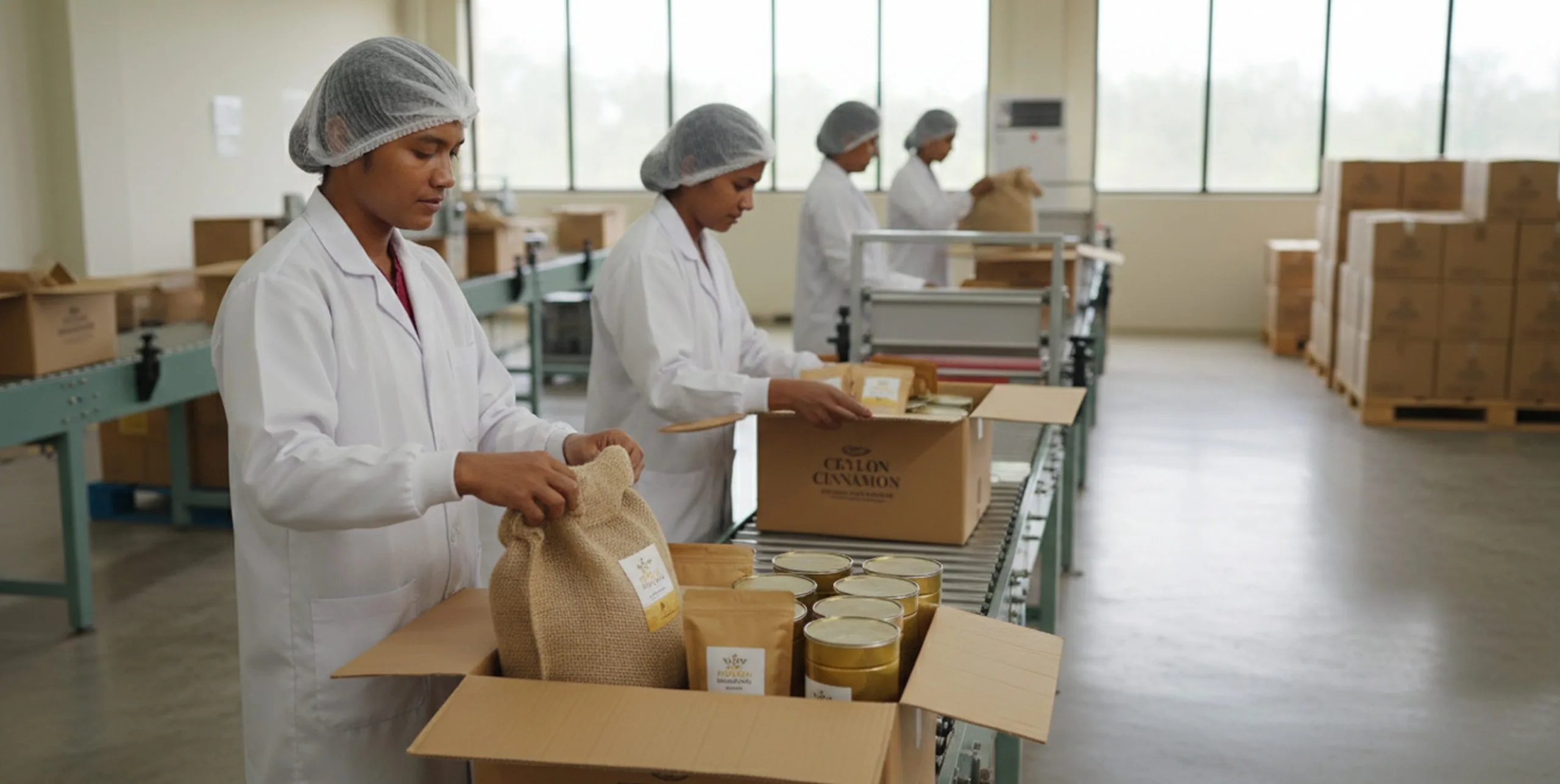
To import Ceylon cinnamon from Sri Lanka, decide the grade and form you need (quills, cuts or powder), request samples, check the exporter’s quality certificates and lab results, agree price and shipping terms, then ship with the required export documents. Sri Lanka supplies an estimated 80 to 90% of the world’s true cinnamon, according to the Ceylon cinnamon GI association, so most buyers deal with a Sri Lankan exporter directly. This guide explains how, and how to compare the top spice exporters in Sri Lanka before you commit.
Why Buyers Import Ceylon Cinnamon from Sri Lanka
Buyers import Ceylon cinnamon from Sri Lanka because it is the only major commercial source of true cinnamon (Cinnamomum verum), which has a milder, sweeter flavour and far less coumarin than cassia. Sri Lanka held about 78% of global export value of dried cinnamon in 2023, worth roughly US$204 million, according to Tridge trade data.
Demand is still growing. Sri Lanka’s Export Development Board reports that cinnamon export earnings rose 29.75% in January to July 2026, and the industry is targeting US$300 million for the year. Mexico takes around 60 to 70% of exports and the United States 11 to 15%, while exporters are pushing into Europe, the Middle East and China.
The health angle matters to food brands and supplement makers. Cassia contains about 1% coumarin against 0.004% in Ceylon, according to Healthline, which is why people who eat cinnamon daily are usually advised to choose Ceylon.
Ceylon Cinnamon Grades Explained: Alba, C5, C4, M and H
Ceylon cinnamon quills are graded mainly by diameter, and thinner quills generally command higher prices. Alba is the thinnest and most premium grade, C5 and C4 are the most common retail and export grades, and the thicker Mexican (M) and Hamburg (H) grades are typically used for grinding and industrial food production.
| Grade family | Grade | Approx. quill diameter | Typical use |
| Continental | Alba | under 6 mm | Gourmet and premium retail |
| Continental | C5 Special | 6 to 10 mm | Premium retail, bakery |
| Continental | C5 | 10 to 12 mm | Retail packs, health products |
| Continental | C4 | 13 to 16 mm | Everyday cooking, retail |
| Mexican | M5 / M4 | up to about 19 mm | Mid-range, Latin American demand |
| Hamburg | H1 / H2 | about 19 to 32 mm | Grinding, industrial use |
Diameters follow the Sri Lanka Standards Institution classification. Exporters quote slightly different ranges, so always write the diameter, quills per kilogram and moisture limit into your purchase specification.
Quills are also sold as cuts, chips, quillings (broken pieces), powder and cinnamon oil. Choose the form by end use: whole quills for retail and premium food, cuts for tea and spice blends, and powder or quillings for manufacturers.
How to Check Ceylon Cinnamon Quality Before You Buy
Check five things before you buy Ceylon cinnamon: that the species is genuine Cinnamomum verum, that the lot meets the Sri Lanka Standard (SLS 81), that moisture is within your agreed limit, that sulphur dioxide residue is within your market’s rules, and that a lab report backs all of it.
- Species and adulteration. Ceylon is roughly twice the price of cassia, so it is a fraud target. An EU Joint Research Centre study found that 58% of 52 commercial cinnamon samples were adulterated or failed quality criteria, including ground products labelled Ceylon that were pure or mostly cassia. Buying whole quills lowers the risk, and a coumarin test on powder confirms the species.
- Visual check. Ceylon quills are thin, light tan and made of many fine layers rolled together, while cassia is thick, dark and a single hard layer.
- SLS 81 conformity. Sri Lankan rules require exporters to furnish a certificate of conformity with the Sri Lanka Standard for cinnamon, so ask to see it for your lot.
- Moisture. Set a maximum in the contract. One UK wholesaler’s specification, for example, uses 12% maximum moisture.
- Sulphur dioxide. Traditional processing uses sulphur fumigation, and the EU permits it for Ceylon cinnamon within set limits. Some buyers ask for much lower residues, so state your limit and your destination’s rules in writing.
Order a lab report for your first shipment covering coumarin, moisture, sulphur dioxide, pesticide residues and microbiology.
Spices Wholesale Price in Sri Lanka: What Drives the Cost
There is no single fixed number, because wholesale spice prices from Sri Lanka change with grade, form, harvest, order volume and currency. For cinnamon, the biggest driver is quill grade, so a quote for Alba will sit well above one for H2 or powder.
Prices have been rising. In mid-2026 the Cinnamon Development Department reported farm-gate prices for Alba grade at a record Rs. 7,500 per kilogram. That is a farm-gate figure paid to growers, not an export price, so processing, packing, certification, freight and the exporter’s margin come on top. Market-data sites such as Tridge publish indicative farm-gate and wholesale prices by grade for benchmarking.
What moves your landed cost:
- Grade and quill length (Alba versus C5, C4 or H grades)
- Form (whole quills, cuts, quillings or powder)
- Organic or other certification
- Packaging (bulk bales, 25 kg bags or retail packs)
- Order size and shipping terms (FOB, CIF or door-to-door)
- Exchange rate and season
Ask every exporter to quote the same grade, quantity and shipping term in writing, so the quotes can be compared fairly. Prices shown here were current at the time of writing and will change.
How to Choose the Best Spices Exporters in Sri Lanka
The best exporter for you is the one that sources directly from growers, grades consistently, shares lab and compliance documents, ships on time and sends samples before you pay for a full order. Reputation matters less than evidence you can check.
Sri Lanka’s cinnamon sector is fragmented, with around 70,000 plantations, about 80% of them smallholders, according to the German-Sri Lankan Chamber of Commerce. Quality therefore varies between suppliers, and a good exporter earns its place by controlling sourcing and processing.
Top 10 Spices Exporters in Sri Lanka: How to Build Your Shortlist
No official ranking of Sri Lankan spice exporters exists, so build your own shortlist. Start with the Export Development Board’s exporters directory, list up to ten companies that supply your product, then score each on the ten criteria below.
| # | Criterion | What to ask for |
| 1 | Direct sourcing | Where the bark comes from and who peels it |
| 2 | Grade consistency | Written grade specs and photos of past lots |
| 3 | SLS conformity | Certificate of conformity for the lot |
| 4 | Lab reports | Coumarin, moisture, sulphur dioxide, pesticides |
| 5 | Certifications | Organic, food safety or GI where you need them |
| 6 | Export experience | Markets served and references from buyers |
| 7 | Sample policy | Free or paid samples of the exact grade |
| 8 | Packaging options | Bulk, retail and private label |
| 9 | Communication | Response time and clear answers on price |
| 10 | Documents and logistics | Invoice, origin and phytosanitary certificates, shipping support |
Compare shortlisted exporters on evidence, not on how many marketplace badges they display. A supplier that answers all ten criteria clearly is usually safe to trial with a small first order.
Pepper Exporters in Sri Lanka: Adding Black Pepper to Your Order
Many importers add Ceylon black pepper to a cinnamon order to save on freight and paperwork, and a supplier that handles both can ship them together. Sri Lanka is a small but quality-focused pepper origin, producing roughly 1.7% of global pepper according to the Export Development Board, with a taste close to Malabar pepper.
Trade commentary also reports that Sri Lankan black pepper has higher piperine content than most origins, which gives it its pungency. Treat that as a claim to confirm with a lab report for your lot.
When you specify pepper, define these points in the contract:
- Density in grams per litre (export lists commonly offer grades such as 550 or 600 g/l)
- Moisture and extraneous matter such as dust, stones and leaves
- Form: whole black pepper, white pepper or ground
- Organic or fair trade certification if your market needs it
The Sri Lanka Standards for pepper (SLS 105) were voluntary for export when last reported, so your own specification and lab testing carry more weight than they do for cinnamon.
Step-by-Step: How to Import Ceylon Cinnamon from Sri Lanka
The import process has eight steps, from writing your specification to clearing customs at home. Allow time for samples and testing before the first full order.
- Write your specification. Set the grade, form, quill length, moisture limit, sulphur dioxide limit and packaging.
- Shortlist exporters. Use the scorecard above and contact three to five.
- Request samples. Ask for the exact grade you will buy, not a showpiece.
- Test the samples. Run a lab check for species (coumarin), moisture, sulphur dioxide and contaminants.
- Agree price and terms. Confirm the quote per kilogram, minimum order, payment terms and shipping term (FOB, CIF or door-to-door).
- Confirm documents. Typical shipments need a commercial invoice, packing list, certificate of origin, phytosanitary certificate, the SLS certificate of conformity and a bill of lading.
- Check destination rules. Importers in the EU, United States, Australia and New Zealand each have food safety and biosecurity requirements. Confirm them with your customs broker before the goods ship.
- Place a trial order, then scale. Start with a small shipment, compare it to the sample, then move to larger volumes.
Why Choose Ceylon Yasasi Spices
Ceylon Yasasi Spices is a Sri Lankan exporter of Ceylon cinnamon, pepper, cloves and other spices, based in Suriyawewa and supplying bulk and retail buyers in Australia, New Zealand and other overseas markets. It sources directly from local growers and focuses on pure, fresh product with consistent grading.
Here is what buyers get when they work with us:
- Direct sourcing. Spices come straight from Sri Lankan growers, hand selected and naturally grown, which keeps the supply chain short and traceable.
- Quality-assured production. Each batch is processed and packed for export-quality standards, with freshness a priority from farm to packaging.
- A range that fits one shipment. Ceylon cinnamon, pepper, cloves, whole spices, spice powders, dried herbs and pure cinnamon oil, so you can consolidate suppliers.
- Bulk and retail supply. We supply wholesale buyers and brands that need smaller retail quantities.
- Samples before you commit. We provide product details and samples on request so you can check quality first.
- Transparent pricing. Because prices move with harvest, grade and volume, we send an up-to-date quote for your product list and order size instead of a fixed public price.
- Catalogue and profile on request. We can send a PDF product catalogue and company profile.
- Quick, direct contact. Message us on WhatsApp at +94 71 575 4293 or +94 71 645 7110, or use the contact page.
To get an accurate quote, tell us the spices you need, the grade, quantity, packaging and destination country. For a first order, we suggest requesting samples of your target grade and testing them against your specification.
Frequently Asked Questions
Who are the top spice exporters in Sri Lanka?
Sri Lanka has many established spice exporters, from large trading houses to specialist cinnamon and pepper suppliers, and there is no official ranking. The Export Development Board keeps a public directory of exporters by product, and you can compare them on sourcing, grading, certificates and sample quality. Ceylon Yasasi Spices is one Sri Lankan exporter focused on Ceylon cinnamon and pepper.
How do I find the best spices exporters in Sri Lanka?
Look for direct sourcing from growers, clear grading, lab reports, SLS 81 conformity for cinnamon, proven export experience and a willingness to send samples. Test the samples against your written specification before placing a full order.
Is there an official Top 10 spices exporters in Sri Lanka list?
No official list exists. The practical alternative is a shortlist of up to ten suppliers that you score on direct sourcing, grade consistency, certificates, lab reports, export experience, samples, packaging, communication and documents.
What is the spices wholesale price in Sri Lanka?
It depends on the spice, grade, form, order size and season, so reliable exporters quote per order rather than publish a fixed price. For reference, farm-gate Alba cinnamon reached a record Rs. 7,500 per kilogram in mid-2026, but that is a grower price, not an export price. Ask for written quotes on the same grade, quantity and shipping term.
Which pepper exporters in Sri Lanka should I consider?
Choose on evidence: bulk density in grams per litre, moisture, cleanliness, lab-tested piperine and the ability to ship with your cinnamon order. Sri Lanka produces about 1.7% of the world’s pepper, so supply is smaller than in Vietnam or India and quality control matters. Ceylon Yasasi Spices exports pepper alongside cinnamon.
What is the difference between Ceylon and cassia cinnamon?
Ceylon cinnamon (Cinnamomum verum) is thin, light, multi-layered and mildly sweet, with about 0.004% coumarin. Cassia is thicker, darker and stronger, with about 1% coumarin, and makes up most cinnamon sold in supermarkets.
Which Ceylon cinnamon grade should I buy?
Buy Alba for premium retail and gourmet use, C5 or C4 for most retail and health products, and H or M grades for grinding and industrial food production. Always confirm diameter, quills per kilogram and moisture in the contract.
How can I tell if Ceylon cinnamon is adulterated?
Buy whole quills where possible, since powder is easier to adulterate. Check that the quills are thin and multi-layered, and request a lab test for coumarin and cinnamaldehyde or eugenol to confirm the species.
What documents do I need to import cinnamon from Sri Lanka?
Typically a commercial invoice, packing list, certificate of origin, phytosanitary certificate, the SLS certificate of conformity and a bill of lading. Your destination country may add food safety or biosecurity requirements, so confirm them with your customs broker.
Can I get samples and a price list from Ceylon Yasasi Spices?
Yes. We provide product details and samples on request, and we send an up-to-date quote and a PDF catalogue once you share the spices, grade, quantity, packaging and destination country. Contact us on WhatsApp at +94 71 575 4293 or +94 71 645 7110.
Which countries does Ceylon Yasasi Spices export to?
We export Ceylon cinnamon, pepper and other Sri Lankan spices to local and international buyers, including Australia and New Zealand. Contact us to confirm availability and shipping terms for your country.